
News
Platform news and market context
News
Platform news and market context
BTCS Reduces Aave Debt with Ethereum, Leaving Quarter-End Cash and Stablecoin Reserves at $317,000
Nasdaq-listed BTCS converted its Ethereum holdings to pay down loans on the Aave protocol during the second quarter, an action that left the company with just $317,113 in cash and stablecoins as of June 30 while its DeFi borrowings remained significant.
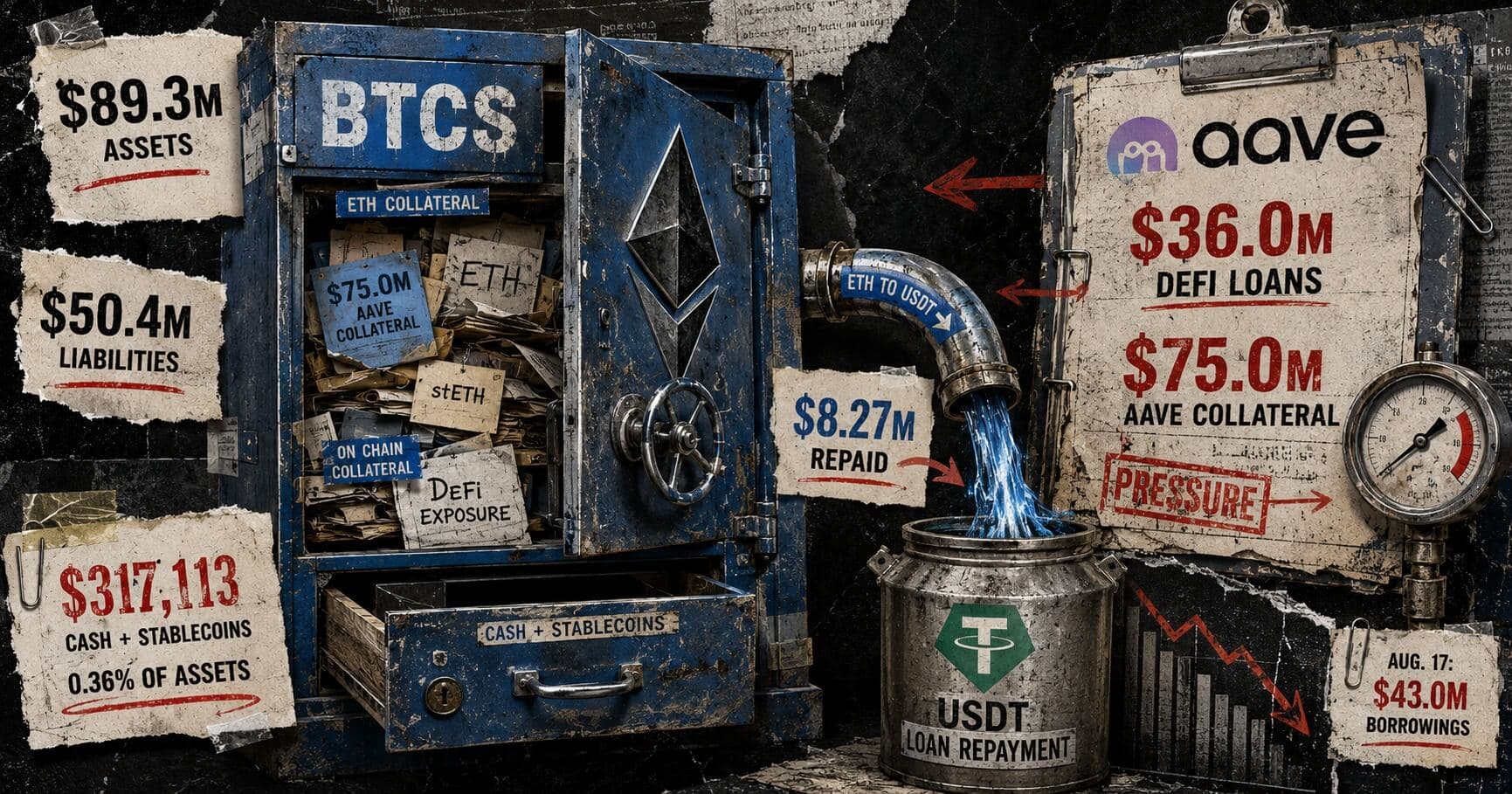
The Nasdaq-listed Ethereum infrastructure company BTCS converted a portion of its ETH holdings into USDT during the second quarter to decrease its outstanding loans on the Aave platform. This strategic move left the firm with a combined total of $317,113 in cash and stablecoins by the quarter's end on June 30.
While its cash position was low, BTCS also possessed approximately $88.1 million in other current digital-asset categories. This indicates the primary issue was not a shortage of assets, but rather the significant exposure of its balance sheet to the volatility of cryptocurrency markets and Decentralized Finance (DeFi).
A comparison of the company's first-quarter and second-quarter filings reveals the specifics of the debt repayment. The transactions involved swapping about $8.27 million worth of ETH for USDT to cover the loan principal, with an additional $381,103 used for accrued interest. In its official results announcement, BTCS summarized this as an $8.2 million repayment to Aave.
Balance Sheet and DeFi Exposure
At the conclusion of the quarter, the company’s financial records showed $89.3 million in total assets against $50.4 million in total liabilities. A substantial portion of these liabilities, $36.0 million, consisted of loans from DeFi protocols. The company’s most liquid assets were composed of $262,436 in cash and $54,677 in stablecoins, which together represented only about 0.36% of its total assets.
Other current assets on the balance sheet included treasury holdings, assets deployed in DeFi, staked digital assets, positions in liquidity pools, and NFTs. Although these holdings contributed to the company's asset value, they differed from idle cash in that they were continuously subject to market fluctuations, protocol-specific risks, and potential collateral calls.
Collateral and Borrowing Dynamics
Over the course of the second quarter, BTCS's reported collateral on the Aave protocol decreased. On March 31, it held approximately 49,970 aEthWETH valued at $105.1 million. By June 30, this had fallen to 47,775 units worth $75.0 million. Concurrently, the company's total DeFi loans declined from $43.8 million to $36 million during the same three-month period. At the end of June, the outstanding loan balance was equivalent to about 48% of the reported collateral's value.
An update provided on August 17 showed that BTCS’s DeFi borrowings, including accrued interest, had risen to $43.0 million. These loans were secured by approximately 46,525 ETH, which had a market value of about $88.7 million, based on a price of $1,905 per ETH. This data indicated that since the end of the quarter, the company's borrowings had increased while its collateral units had decreased, though the dollar value of that collateral had recovered. BTCS affirmed that it had not suffered any full or partial liquidations up to that date.
Performance, Profitability, and Future Outlook
When checked on August 20, the price of Ethereum was near $2,336, which was higher than the valuation used in the August 17 report. However, this price rebound does not provide insight into any changes to the company's debt or collateral position after August 17. BTCS has not disclosed the specific price point at which its position would face liquidation.
The company's reported net loss of $34.9 million for the second quarter was not a direct measure of its cash consumption. This figure was primarily composed of $21.4 million in unrealized losses on digital assets and $4.9 million in realized transaction losses. Furthermore, many of the DeFi-related settlements were categorized as non-cash activities. The net cash utilized in operating activities for the entire first half of the year was a much smaller $1.3 million.
Despite the net loss, BTCS achieved a second-quarter gross profit of $1.5 million, reflecting a strong 61% margin. Its DeFi revenue for the period also stood at $1.5 million. While stronger margins helped the company's operational standing, the earlier ETH-to-USDT swaps demonstrate that managing collateral can require the consumption of crypto assets during periods of declining market values.
Without a more current snapshot of its debt, collateral levels, and loan health factor, the Ethereum price rally on August 20 is insufficient to determine if another market decline would necessitate a further sale of its digital assets.
Discussion about this post
No comment yet
Be the first to share your opinion!