
News
Platform news and market context
News
Platform news and market context
Canaan's July Hashrate Figures Boosted by Paused Ethiopian Mining Operations, Representing 35% of Total
Canaan's July mining report declared a global operating hashrate of 14.24 EH/s, with nearly 35% (4.96 EH/s) attributed to paused operations in Ethiopia. This discrepancy is explained by the company's definition of "operating computing power" as a theoretical maximum of energized machines, not a measure of live output.
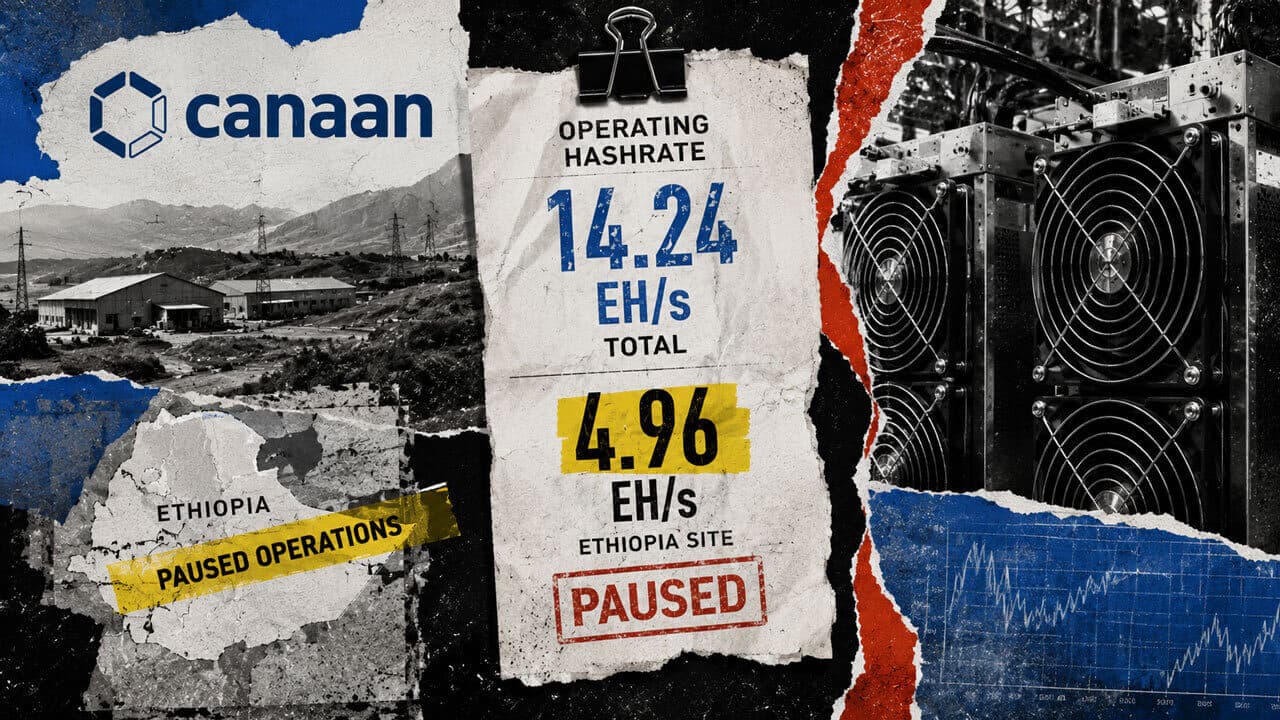
In its mining update for July, Canaan incorporated 4.96 exahashes per second (EH/s) from halted operations in Ethiopia as part of its 14.24 EH/s total for global operating computing power. This contribution from the paused Ethiopian sites constitutes nearly 35% of the company's reported total, yet Canaan did not specify how much of that capacity was actively hashing at the close of the month.
A simple subtraction of the Ethiopian hashrate from the global figure yields 9.28 EH/s. However, this should be viewed as an exclusion calculation, not a measure of live hashrate, because Canaan's definition for "operating computing power" is significantly broader than a real-time reading.
Defining "Operating" Capacity
Canaan clarifies that its metric for operating computing power is the theoretical output of its energized mining machines, based on the assumption that all were fully operational. This definition allows for the inclusion of machines that are temporarily offline and pertains to the company's operations that are not joint ventures.
The July report's data table assigned the full 4.96 EH/s to two projects in Ethiopia under both the "operating" and "installed" capacity columns. A corresponding footnote, labeled as Footnote 10, specified that Canaan had paused its mining activities in Ethiopia but was maintaining the hashrate figure within its installed capacity. The filing provided no details on whether the paused machines remained energized or what portion, if any, was actively hashing on July 31.
A Shift from June's Reporting
This reporting marks a change from the company's status at the end of the previous month. As of June 30, Canaan had listed Ethiopia with only 0.36 EH/s of operating computing power, despite having 4.96 EH/s of installed capacity. At that time, Canaan stated the reduction was primarily because one mining site had gone temporarily offline in mid-June due to maintenance on the local power grid.
One month later, the July report restored Ethiopia’s operating hashrate to the full 4.96 EH/s, even while the new footnote described the country's mining operations as being paused. The two disclosures do not confirm whether the July pause shared the same cause as the June issue, or if Canaan continued to consider the stoppage temporary. These documents also illustrate why the 9.28 EH/s subtraction cannot be taken as an adjusted live total, given the specific classifications used in the tables.
Implications for Production and Totals
The scope of Canaan's reporting methodology also complicates direct comparisons with its production figures. For July, the company reported mining 46 BTC and holding reserves of 1,917 BTC and 3,952 ETH at the end of the month. However, these production numbers are not comprehensive of every project listed in the global capacity table.
Canaan employs separate reporting for its 49%-owned joint ventures in West Texas, which include the Alborz, Bear, and Chief Mountain projects. The company explicitly states that the output from these joint ventures is not included in its Bitcoin production figures or its average all-in power-cost calculations. Nevertheless, the capacity from these joint ventures is factored into the global projects table.
Ultimately, Canaan’s 14.24 EH/s figure is most accurately understood as the company's total operating capacity based on its own theoretical definition, rather than its active hashrate.
Discussion about this post
No comment yet
Be the first to share your opinion!