
News
Platform news and market context
News
Platform news and market context
Circle Secures Federal Bank Charter, Fueling Lenders' Fears of a $500 Billion Deposit Drain from Stablecoins
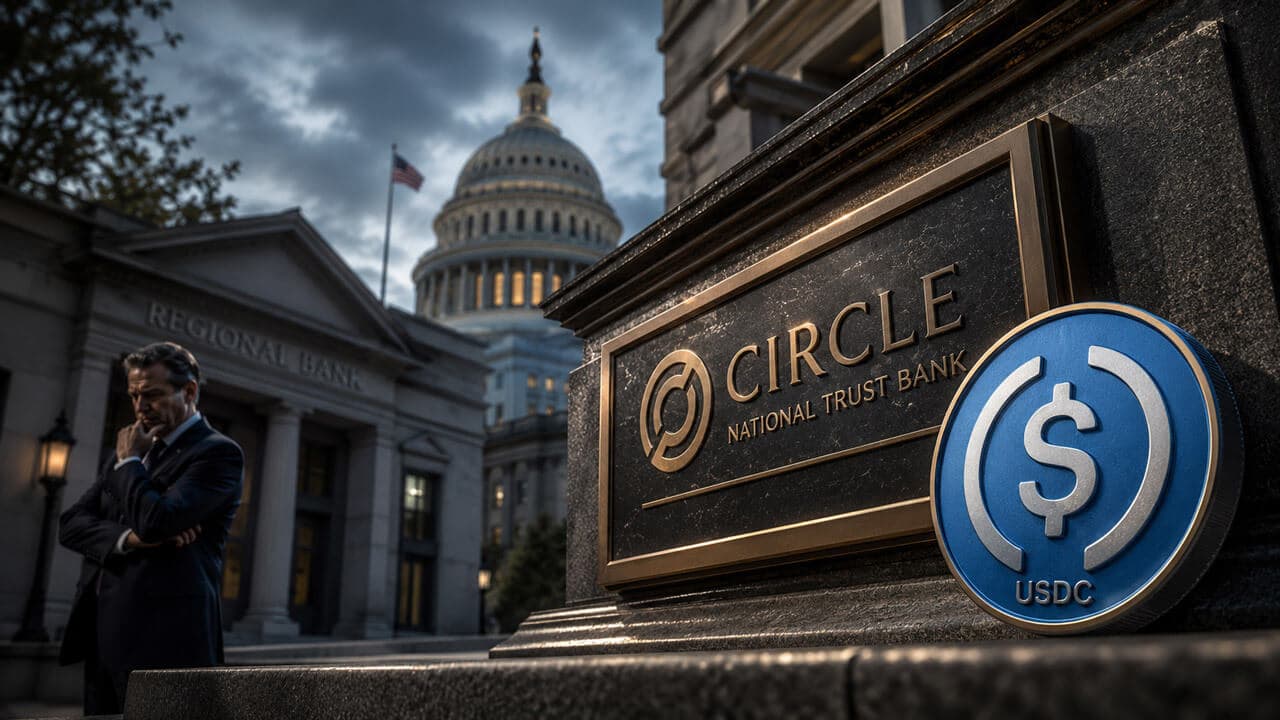
Circle has received final approval from the OCC to operate a federal trust bank, a move that bolsters USDC's legitimacy but also intensifies warnings from lenders that stablecoins could siphon up to $500 billion from the US banking system by 2028 and significantly curtail lending.
A Landmark Approval and a Looming Threat
A major digital currency has gained a more formal position within the United States financial system after a key decision by regulators in Washington. On July 10, the Office of the Comptroller of the Currency (OCC) granted Circle its final approval to establish a national trust bank operating under federal supervision.
Circle celebrated the decision, describing it as a significant step forward for its USDC stablecoin. According to the company, the approval provides a clearer path for banks, asset managers, payment firms, and corporate treasury departments to integrate USDC into their operations, treating it as a foundational financial asset.
However, the banking industry views this development with significant apprehension. In a January report, Standard Chartered projected that the growing adoption of stablecoins could lead to a withdrawal of approximately $500 billion from US bank deposits by the close of 2028. The Federal Reserve, meanwhile, has outlined an even broader spectrum of potential consequences. A FEDS Note from December 2025 estimated that stablecoin adoption could reduce bank lending by a figure ranging from $65 billion to as high as $1.26 trillion, with the final impact depending on the rate of adoption and how issuers manage their reserve assets.
Understanding Circle's New Charter
While Circle now possesses a federal banking charter, it is not the type that transforms the company into a traditional lender with branches, checking accounts, and insured deposits. The new entity is specifically a national trust bank.
According to Circle’s own announcement, Circle National Trust will initially focus on providing fiduciary digital-asset custody for Circle and its associated companies. The management of reserves is identified as a potential future service. The OCC’s conditional approval, which was first issued on December 12, 2025, defined the proposed entity as a "trust bank" engaging in "trust-company" activities, explicitly stating that the bank would remain distinct from the function of issuing stablecoins.
For Circle, securing a federal trust-bank structure centered on custody and fiduciary services represents a meaningful victory. Although it does not involve the typical business of collecting retail deposits to fund mortgages and business loans, the federal oversight provides institutional counterparties with a much clearer regulatory framework for using USDC.
This development serves to sharpen a long-held fear within the banking sector, particularly among smaller institutions. They are concerned that stablecoins can achieve official legitimacy and widespread institutional use while directly competing with deposit-taking banks that operate under traditional obligations and funding models.
A Shift in Legitimacy and Policy
The charter effectively functions as an upgrade to Circle’s credibility. For years, stablecoins have occupied an ambiguous space between crypto trading tools and genuine financial infrastructure. Supervision by the OCC decisively pushes USDC into the latter category.
This move aligns with a broader trend in Washington, where the policy debate has evolved beyond questioning the existence of stablecoins. The central argument now revolves around their supervision, their role in the financial system, and how closely they should be permitted to resemble products like bank deposits.
An examination of Circle’s transparency page, which was updated on July 13, revealed $72.95 billion worth of USDC in circulation, backed by total reserve assets of approximately $73.15 billion. Of these reserves, around $11.55 billion were held in bank deposits. The majority, $61.60 billion, was allocated to overnight reverse Treasury repo agreements and Treasury bills with maturities of less than three months. This reserve composition keeps dollars within the financial system but diverts most of them away from traditional bank deposit funding.
The Mechanics of a Funding Shift
The common description that stablecoins "pull money out of banks" is not entirely accurate. The process is more nuanced. For instance, a customer might withdraw $1,000 from a regional bank to purchase USDC. Circle then backs that USDC by placing the $1,000 into its reserves, such as cash, repo, or Treasury bills. The party that sells those Treasury bills to Circle might then deposit the proceeds into another bank account. The dollars, therefore, remain within the banking system; what has changed is the location and nature of the funding.
This very dynamic, however, is the core of the banking industry's concerns. A regional lender's ability to extend credit is based on the deposits it holds, not on the total amount of dollars in the national economy. If those customer balances shift to a massive institution, a Treasury-dominated reserve fund, or another short-term investment vehicle, the local bank loses a cheap and stable source of funding. This is how a stablecoin can alter credit conditions even if the aggregate supply of dollars remains largely unchanged.
The December 2025 FEDS Note frames this not as a cultural clash between finance and crypto, but as a structural funding problem. The paper demonstrates that the impact hinges on three key variables: the source of demand for stablecoins, what assets users are forgoing to buy them, and where issuers invest the reserve funds.
The note's wide range of lending impact estimates—from $65 billion to $141 billion in a low-adoption scenario, $190 billion to $408 billion in a moderate case, and $600 billion to $1.26 trillion in a high-adoption scenario where issuers get access to Federal Reserve master accounts—reflects this complexity.
The Real-World Impact on Credit
The transmission mechanism for this impact is broad, meaning stablecoins can alter the composition of funding long before they cause a dramatic shift in the quantity of dollars. For community and regional banks, this compositional change is critical. Deposits that are moved into a systemically important bank or into a reserve structure dominated by repo and Treasury bills still exist, but they are no longer available as low-cost funding for local lenders.
Circle's own reserve allocation illustrates this pressure clearly. As of July 13, roughly 84% of its reserves were in repo and short-term Treasuries, with only about 16% remaining in bank deposits. This structure is a logical response for a stablecoin issuer, especially after the 2023 USDC shock related to Silicon Valley Bank, as it prioritizes liquidity, short duration, and assets that are easily defended in a crisis. From a small lender's perspective, however, that same structure signifies a shift of transactional balances away from relationship banking and toward government-backed assets.
This redirection of funds directly affects credit availability. A smaller bank facing deposit outflows has few good options:
- It can increase interest rates to retain depositors, which squeezes profit margins.
- It can turn to wholesale markets for funding, which is typically more expensive and less stable.
- It can slow the growth of its balance sheet or reduce lending altogether.
At its core, therefore, the stablecoin debate is a debate about the supply of credit. As stablecoins become more accessible, deposits become harder for banks to retain, and as deposits become more difficult to keep, credit becomes harder to supply.
The potential for stablecoins to offer yield complicates the issue for banks even further. A stablecoin used primarily for payments already competes with traditional transaction accounts by offering speed, portability, and 24/7 settlement. When third-party rewards, exchange incentives, or adjacent tokenized cash products are introduced, these products begin to compete with savings accounts as well. This has raised a major policy question for regulators: at what point should a private digital dollar be regulated like a bank deposit?
A New Competitive Landscape
Banks often draw a parallel between stablecoins and money-market funds, and a May 2026 follow-up note from the Federal Reserve explains why. Stablecoins operate on programmable, cross-border rails that offer instant settlement. They can achieve rapid, widespread adoption through digital platforms much faster than previous competitors to bank deposits. Furthermore, they have an international component, as foreign demand for dollar-denominated stablecoins can partially offset domestic outflows if the reserve funds remain in US banks.
Recognizing the threat, banks have already begun to develop their own tokenized deposits and bank-backed stablecoins. This is the typical response of an industry that sees a new product category taking direct aim at its funding base.
Circle’s charter has provided its institutional partners with a compelling reason to view USDC as a product they can integrate into custody, settlement, and treasury functions without the reputational risk of previous years. While this does not guarantee mass adoption or resolve all outstanding legal questions, it makes the next phase of adoption easier to envision. With stronger federal backing, more institutions can now use USDC, allowing greater payment and settlement volumes to flow through a privately issued digital dollar.
While enhanced, better-supervised dollar infrastructure can deepen liquidity and expand the use of onchain dollars in everyday finance, the perspective from the banking sector is starkly different. What is seen as an improved settlement rail for one industry can simultaneously weaken the deposit franchise of another.
Consequently, Circle’s OCC approval is more than just a regulatory achievement for a single company; it signals Washington’s intended direction for stablecoins. The government is no longer treating them as a mere byproduct of crypto trading but is creating a path for them to enter the federally supervised financial system. This is happening even as banks continue to warn that these same products could erode the funding base that supports local credit. The old battle over legitimacy is waning, making way for a more fundamental conflict over who controls the nation's dollars and the lending power that comes with them.
Discussion about this post
No comment yet
Be the first to share your opinion!