
News
Platform news and market context
News
Platform news and market context
T. Rowe Price Enters Crypto ETF Race with Multi-Token Fund, Challenging Investor Apathy Toward Baskets
With roughly $1.89 trillion under management, T. Rowe Price is launching an actively managed multi-token crypto ETP called TKNZ. This move directly tests why previous crypto basket funds have failed to attract investors, who have so far overwhelmingly preferred single-asset ETFs.
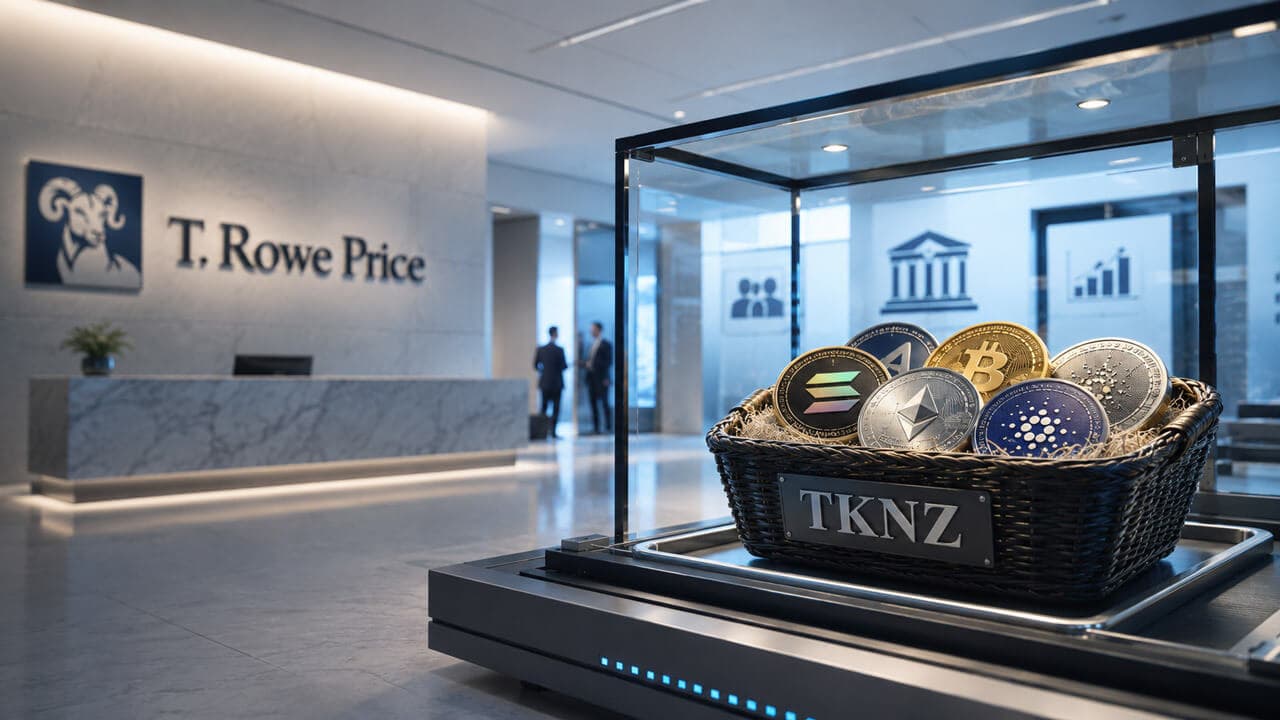
T. Rowe Price, a financial heavyweight managing approximately $1.89 trillion, has made a significant entry into the cryptocurrency market. The firm is deeply entrenched in the retirement, adviser, and institutional sectors—which constitute about 66% of its assets—representing the very relationships the crypto industry has long sought to cultivate.
A Contrarian Bet on Crypto Baskets
The company's inaugural crypto vehicle is TKNZ, a spot exchange-traded product (ETP) that commenced trading on the NYSE Arca on July 16. It has been structured as a diversified multi-token basket, a strategy that places it directly in the most underperforming segment of the crypto ETF market to date.
Data reveals a stark contrast in investor appetite. While single-asset spot ETFs that track cryptocurrencies like Ethereum, XRP, and Solana have attracted a combined total of roughly $13.6 billion (excluding Bitcoin), four comparable multi-asset products built from the ground up—NCIQ, EZPZ, TTOP, and TXBC—have only amassed about $161 million over a similar period. Even accounting for timing differences, the disparity in asset accumulation is significant.
The Original Thesis and Its Shortcomings
This outcome defies the expectations of several well-known crypto analysts. The prevailing assumption was that professional allocators would eventually transition from selecting individual tokens to purchasing the asset class as a whole.
- Matt Hougan had argued that many traditional investors lack strong preferences between assets like Ethereum and Solana and would favor broad market exposure.
- Roxanna Islam predicted that the growing number of new crypto ETFs would inundate adviser due diligence processes, steering buyers toward more straightforward basket products.
- Nate Geraci expressed his bullish sentiment for one-click crypto exposure solutions.
- James Seyffart anticipated that index-style crypto ETPs would establish themselves as a major category within the year.
However, the market has not evolved this way. As of mid-2025, pensions and endowments constituted less than 5% of the assets in spot Bitcoin ETFs, with retail investors continuing to be the dominant force in the category.
Why Baskets Have Struggled
Several factors may explain the lukewarm reception for basket funds. For a conviction buyer, such as one specifically targeting Ethereum's recovery potential or XRP's payment-focused thesis, there is little incentive to dilute that specific bet across eight other tokens selected by a third party.
Furthermore, the crypto space lacks an equivalent to the S&P 500—a universally accepted benchmark defining the investable market. Consequently, each basket must navigate contentious decisions regarding which tokens meet criteria for decentralization, liquidity, and legal eligibility. In essence, purchasing an index means transferring the critical choice of token selection to the index's creator.
For example, Hashdex's NCIQ, which is one of the more affordably priced baskets with a 0.25% fee, allocates nearly 90% of its holdings to Bitcoin and Ethereum. Most investors could easily replicate this exposure with just two single-asset ETFs while retaining complete control over the weighting themselves.
During periods when altcoins have underperformed, diversifying away from Bitcoin has been perceived as a hindrance rather than a protective cushion, unlike how a bond allocation can soften a stock portfolio's downturns. An adviser is left with a difficult conversation when explaining a client's investment in a basket of underperforming tokens.
The track record of existing products reinforces this narrative. Bitwise's BITW has experienced approximately $328 million in redemptions over the trailing year. Similarly, Grayscale's GDLC witnessed substantial withdrawals after its conversion into an ETF. While such conversions allow legacy shareholders in older, less liquid structures to finally exit at net asset value—meaning outflows represent both old holders cashing out and a verdict on new demand—the category was nevertheless left with the appearance of investors heading for the exits.
Testing a New Approach with TKNZ
T. Rowe Price's TKNZ introduces a novel combination of four advantages to this challenging category. Firstly, the firm brings its established adviser and retirement-platform relationships, which was a foundational assumption of the original basket thesis.
Secondly, the fund is actively managed. This gives it the flexibility to adjust portfolio weights based on fundamental analysis and market momentum, and to hold cash or stablecoins during unfavorable market conditions. This active approach differs sharply from the mechanical, hold-every-qualifying-token model of older baskets.
Thirdly, T. Rowe is transparent about the fund's strategy, openly marketing its own expert judgment in determining which tokens are worthy of investment.
This unique combination positions TKNZ as a crucial test for three distinct hypotheses explaining the struggles of previous basket funds:
- A distribution gap prevented issuers from reaching the right investors.
- Investors specifically rejected passive, Bitcoin-heavy baskets.
- Investors have a genuine, fundamental preference for picking tokens directly.
The Verdict Ahead
If TKNZ fails to attract significant capital, the third explanation—that investors prefer direct token selection—will be considerably more difficult to dismiss.
Conversely, if TKNZ secures between $300 million and $750 million in net new assets during its first quarter (excluding its initial seed capital), it would demonstrate that T. Rowe's distribution network and active management strategy can access capital that crypto-native basket issuers failed to reach. Sustained adviser placement and asset retention, especially through any period of altcoin weakness, would elevate this from a single fund's successful launch to evidence that the basket thesis simply needed the right kind of issuer.
However, if net creations remain below the $25 million to $50 million range despite T. Rowe's brand recognition and reach, it would strongly suggest that institutional and adviser demand for diversified crypto exposure is still negligibly small at any meaningful scale.
The definitive evidence will emerge from TKNZ's asset gathering over its first quarter, once seed capital is excluded. Key metrics to watch will be whether that capital flows through adviser platforms—the channel the original thesis depended on—and whether it remains invested through the market's next bout of altcoin turbulence. That window will finally provide the industry with a clear signal on whether professional money is ready to embrace crypto as a portfolio component.
Discussion about this post
No comment yet
Be the first to share your opinion!