
News
Platform news and market context
News
Platform news and market context
KuCoin Implements Automatic Shift to Hourly Settlements for Perpetual Contracts Hitting Funding Rate Limits
KuCoin has enacted a new policy for its perpetual contracts, automatically shifting them to hourly funding settlements whenever their funding rate hits a predefined cap or floor. This accelerated settlement period lasts for a minimum of 36 hours before the contract can revert to a less frequent schedule.
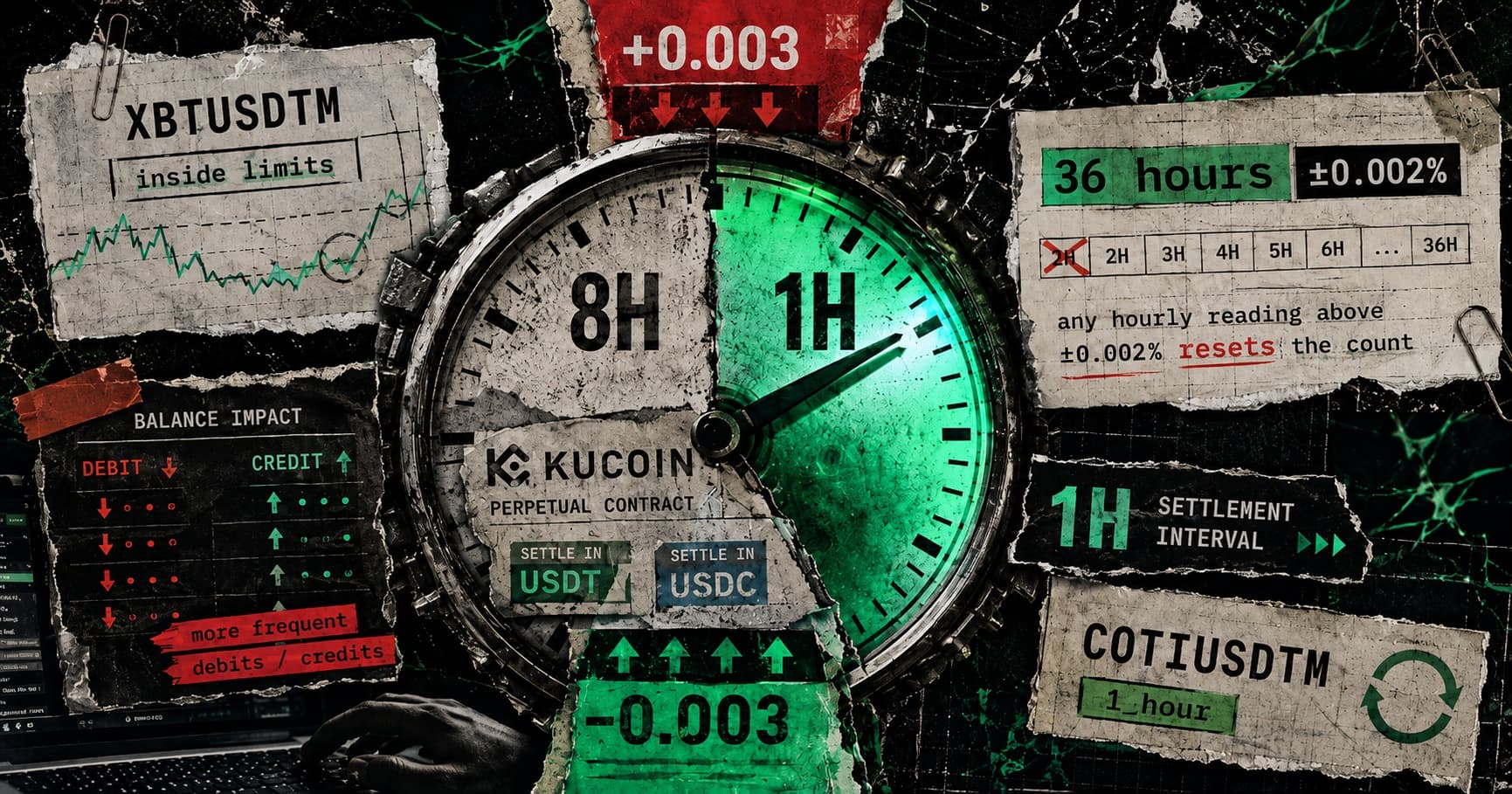
Effective after 08:00 UTC on August 17, KuCoin has implemented a new regulation that automatically adjusts the settlement frequency for its USDT- and USDC-margined perpetual contracts. When a contract reaches its designated funding cap or floor, it will switch to an hourly funding settlement schedule, a change that takes effect from the subsequent funding period. This transition occurs without any separate notification and results in more frequent funding debits and credits for traders holding open positions.
How the Mechanism Works
The mechanism is initiated by the funding rate at a regularly scheduled settlement. Should this rate be equal to or greater than the contract's upper boundary, or equal to or less than its lower boundary, KuCoin will shift the contract to a one-hour settlement interval, provided it isn't already on one. According to the exchange, this adjustment exclusively alters the settlement frequency. Key elements such as the funding calculation methods, the funding limits themselves, and the status of users' positions will not be affected. While this means traders may see funding credited or debited more frequently, the total cumulative cost remains a function of the realized rates, the direction and magnitude of the position, and its duration.
Reverting to a Slower Schedule
To exit the accelerated hourly settlement phase, a contract must undergo 36 consecutive one-hour settlements where the absolute funding rate does not exceed 0.002%. If any single hourly settlement surpasses this threshold, the 36-hour count is reset. Upon successfully completing all 36 qualifying periods, the contract's schedule will transition from hourly to a four-hour settlement interval beginning with the 37th period. This reversion to a slower schedule also occurs automatically, without a specific announcement.
It is important to note that KuCoin does not impose a single, universal cap or a standard starting interval across all its contracts. In its announcement of the new rule, the exchange provided an illustrative example of a Bitcoin perpetual contract that had upper and lower funding limits set at +0.3% and -0.3%, respectively.
Market Impact on Day One
A review of KuCoin's live contract data on August 17 at 20:15 UTC provided a snapshot of the rule's impact. The live XBTUSDTM contract data displayed a cap of 0.003 and a floor of -0.003 with an eight-hour settlement interval. As its current funding rate at that time was within these specified limits, the contract had not been switched into the new mechanism's hourly phase.
A broader examination of KuCoin's active-contract data from the same moment revealed that only the COTIUSDTM contract was operating on an hourly interval. However, this particular contract's hourly cycle had commenced on July 28, following a separate KuCoin notice issued before the new automatic rule was implemented. Consequently, this observation on the rule's first day did not identify any contract newly entering the automatic hourly state, though it doesn't exclude the possibility that a contract might have been briefly activated and reverted earlier in the day.
Implications for Traders
Ultimately, the primary implication for traders revolves around timing. A contract hitting its funding limit can now trigger a shift to hourly balance sheet events starting from the very next funding period. Reverting to a less frequent schedule is a more prolonged process, necessitating a minimum of 36 straight hours of qualifying low funding rates. Despite the change in frequency, the amount of each individual funding transfer continues to be determined by the realized rate.
Discussion about this post
No comment yet
Be the first to share your opinion!