
News
Platform news and market context
News
Platform news and market context
TON Strategy's Q2 Report Shows $15M in Staking Gains Fail to Cover $10.6M Operational Cash Burn
TON Strategy's latest financial disclosure reveals a significant gap between its income and cash reality, showing over $15 million in Gram staking revenue and a 17% annualized yield, while its continuing operations consumed $10.6 million in cash during the first half of the year.
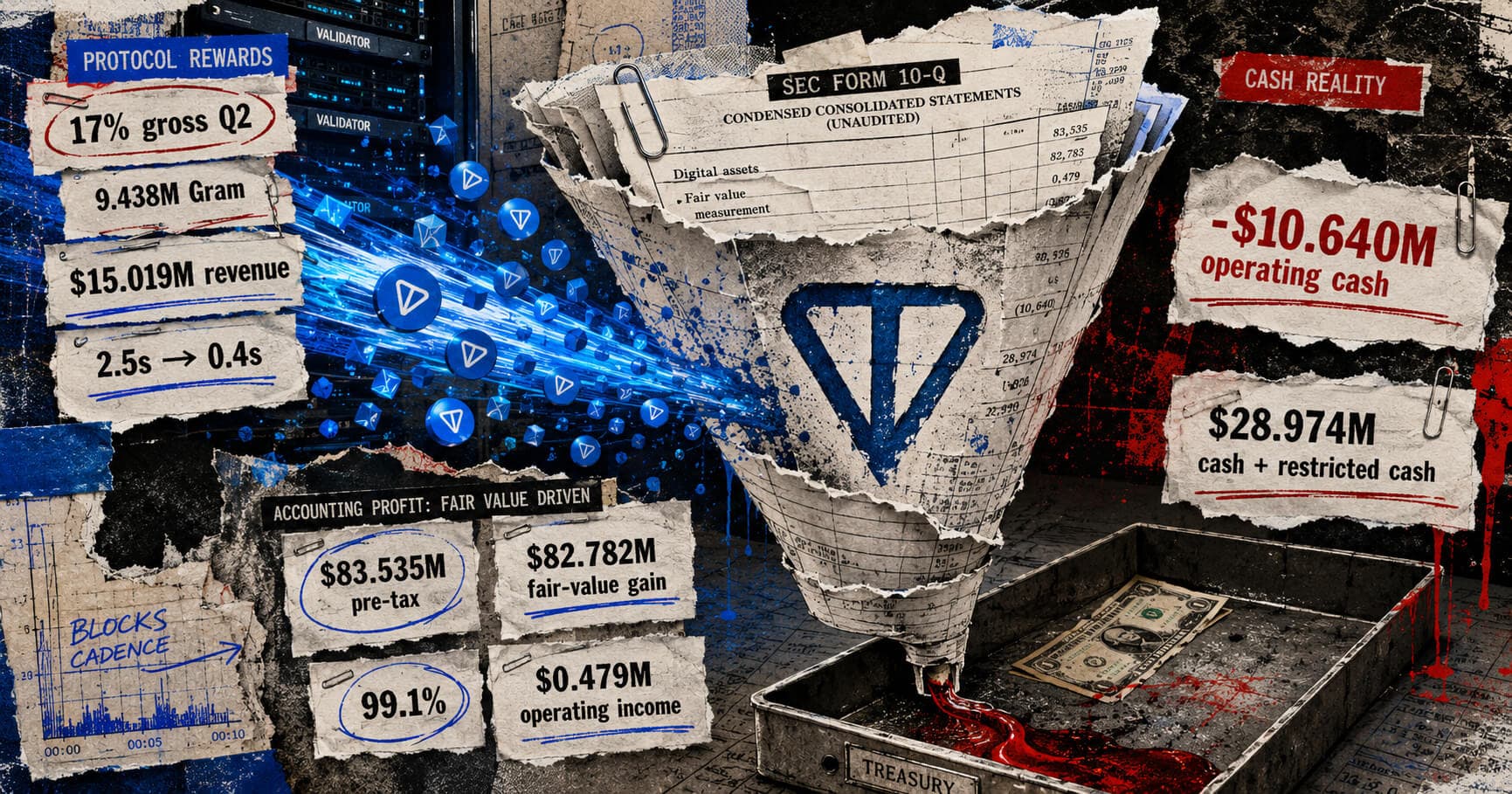
A recent financial disclosure from TON Strategy has illuminated a significant contrast between its token-based earnings and its operational cash flow, despite the company reporting an annualized gross staking yield of 17% for the second quarter. The new filing reveals that while the company generated substantial revenue from staking, its cash reserves were depleted by ongoing operations.
Financial Performance Overview
TON Strategy recognized revenue exceeding $15 million from staking after it received 9,438,177 Gram, the native token of the TON blockchain formerly known as Toncoin. However, the company's impressive $83.5 million in pre-tax income from continuing operations was predominantly fueled by a non-cash item: an $82.8 million net fair value gain on its digital asset holdings. In contrast, its operating income from these same continuing operations was a much smaller $479,000.
The firm’s cash position tells a different story. For the first half of 2026, continuing operations utilized $10.6 million of operating cash. TON Strategy concluded the month of June with its cash and restricted cash reserves at nearly $29 million. According to its SEC-filed earnings release, the company possessed a debt-free balance sheet. While this lack of debt mitigates immediate liquidity concerns, the staking income during the verified period was insufficient to cover the company's cash expenditures.
Accounting for Staking Rewards
The discrepancy between revenue and cash flow stems from how staking rewards are recorded. The company's filing classifies the received Gram tokens as non-cash consideration. This accounting practice permits revenue to be recognized before the token rewards are converted into actual cash. Reinforcing this point, the company's cash-flow reconciliation for the first half of the year shows a deduction of almost $19 million in non-cash Gram consideration from its net income. The cash-flow statement is structured to clearly distinguish between token accruals and fair-value adjustments and the operating cash they might later generate.
TON Strategy clarified that its stated second-quarter reward figure, which equates to an annualized gross staking yield of approximately 17%, is an extrapolation based on a single quarter's results. This percentage does not represent a net return for shareholders nor does it account for company-wide expenses.
Drivers of Increased Staking Yield
The company credits the significant rise in its rewards primarily to the implementation of Catchain 2.0. This April network upgrade dramatically shortened the TON mainnet's block interval, reducing it from approximately 2.5 seconds to around 400 milliseconds. This change resulted in the production of about 6.25 times more blocks per second.
As outlined in TON documents, creation rewards are issued on a per-block basis, meaning a faster block cadence can lead to more tokens being distributed to validators. The final outcome of these rewards can be influenced by several factors, including protocol settings, the total amount of Gram being staked on the network, and the token's market price.
Holdings and Market Position
As of June 30, TON Strategy's portfolio included 230.5 million Gram, with 229.9 million of those tokens actively staked. Citing data from TonStat as of August 4, the company stated that its holdings accounted for roughly 4.4% of the total Gram supply and represented about 35% of all Gram staked on the network. Current LiveTonStat data corroborates the general description of the company controlling about one-third of the network's staking, though the public dashboard does not maintain the specific dated denominator used in the company’s calculation.
For its staking operations, TON Strategy's filing indicates that its holdings are managed and staked by BitGo and Blockchain.com through dedicated pools. The filing also notes that these custodians have the option to engage third parties to operate the necessary validator infrastructure.
Ultimately, while the second quarter delivered considerable token rewards, the company’s continuing operations still consumed cash in the first half of the year. For TON Strategy to achieve sustained cash generation, the Gram rewards it earns must maintain sufficient value to cover expenses as network conditions evolve, and this must occur in tandem with reduced cash consumption from its continuing operations.
Discussion about this post
No comment yet
Be the first to share your opinion!