
News
Platform news and market context
News
Platform news and market context
Trump-Backed USD1 Stablecoin Contains Undisclosed Wallet Controls, Justin Sun Alleges
Tron founder Justin Sun claims World Liberty Financial's $4 billion USD1 stablecoin has on-chain functions for seizing funds from frozen wallets that are not present in its public GitHub code, escalating an ongoing legal and public dispute between the two parties.
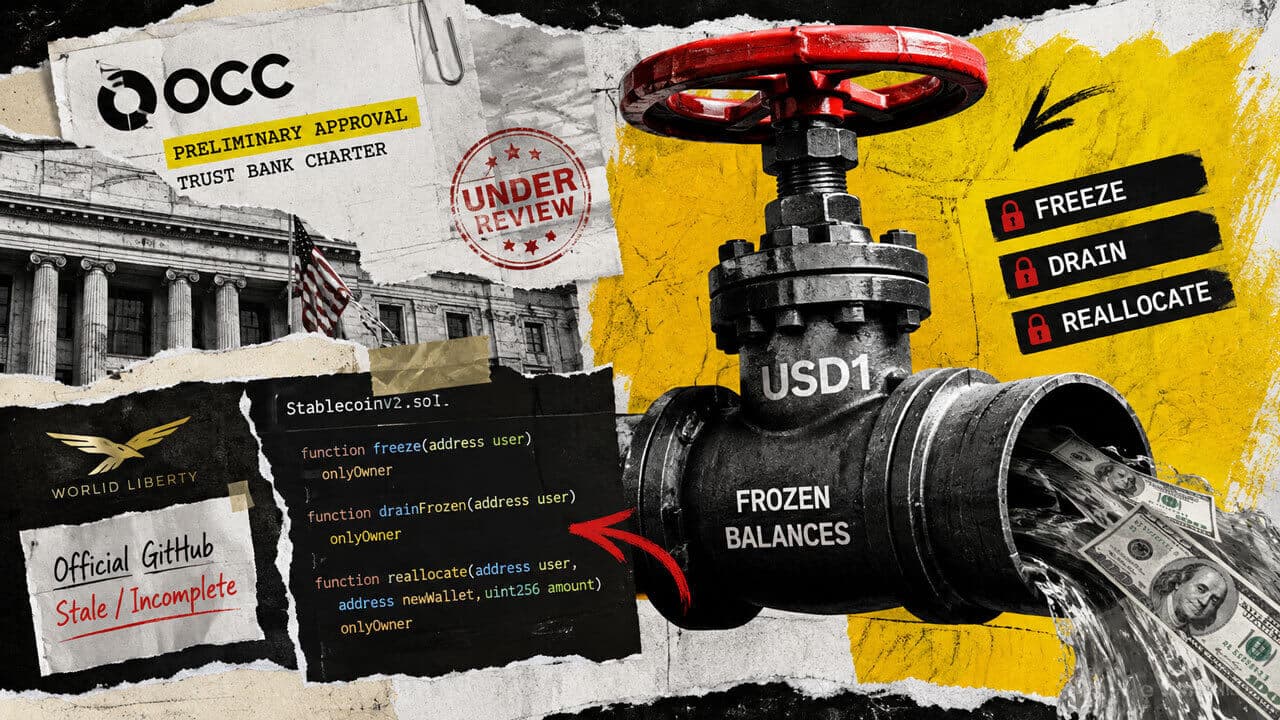
The public conflict between Tron founder Justin Sun and the Donald Trump-affiliated World Liberty Financial intensified on Friday after Sun accused the firm’s USD1 stablecoin of containing hidden administrative powers. Sun alleges these functions allow privileged operators to move funds from frozen wallets without the consent of the account holder.
On August 21, Sun asserted that the source code World Liberty has published does not align with the contract actively running on the blockchain. He argued this discrepancy is evidence of a deceptive deployment, likening it to the methods used in rug pulls.
On-Chain Powers and Code Discrepancies
According to Sun, the live implementation of USD1 possesses the ability to drain or reallocate balances after an address has been frozen. This means security measures like cold storage or multisignature custody would offer no protection against intervention at the token-contract level. Sun also made a similar claim that privileged functions were retrospectively added to the WLFI token.
“USD1's highest-level permissions allow the issuer to move USD1 out of YOUR account into its own wallet — or anyone else's — without your consent,” Sun stated. “Cold wallet? Multisig? Doesn't matter. The authority operates at the token contract level. Nothing you do can stop it.”
The USD1 stablecoin functions via an upgradeable proxy contract that was updated to its current StablecoinV2 implementation on April 5. This version indeed includes drain and reallocate functions applicable to frozen accounts. A technical review of the contract confirms that the drain function transfers the entire balance of a frozen address to the contract owner. Meanwhile, the reallocate function can move a designated amount from one frozen address to another.
Critically, neither of these actions requires authorization from the holder of the affected wallet. This validates Sun's assertion that a user's personal custody setup cannot override these controls once an address is frozen. However, these functions are not accessible to arbitrary users and do not permit unrestricted transfers from any wallet; they are restricted to privileged administrators and operate exclusively on frozen balances.
The GitHub Disclosure Gap
The more pressing concern is the gap between the deployed contract and the code available in World Liberty's public repository. The project’s GitHub code displays functions for minting, burning, freezing, and pausing the token. However, it omits the drain, reallocate, and V2 initializer functions that are present in the live on-chain implementation.
While the deployed code is publicly visible on verified blockchain explorers, meaning the functions are not technically hidden from direct inspection, a developer or investor who relies solely on World Liberty's own repository would not be aware of the complete set of administrative powers governing USD1.
This distinction is important. Centralized stablecoins frequently include intervention capabilities; for instance, the issuers of USDT and USDC can freeze or blacklist addresses. BitGo, the current technical provider and issuer for USD1, states in its terms that it reserves the right to freeze or upgrade USD1 and, under certain legal or compliance scenarios, may render assets permanently inaccessible. Such disclosures make the existence of centralized controls less surprising, but they fail to explain why World Liberty's public repository has not been updated to match its deployed contract.
An Escalating Feud
These allegations mark a new chapter in a months-long dispute between Sun and World Liberty. Sun was an early investor in the project, having committed $45 million to WLFI. The relationship soured after World Liberty restricted his token access, accused him of improper asset transfers and activities designed to manipulate WLFI’s price, and subsequently sued him for defamation, all of which Sun denies.
The legal battle flared up again on August 20, when Sun claimed a procedural victory that he said would keep his personal claims against World Liberty within federal court. A day later, he broadened the conflict to USD1, framing the code mismatch as proof of a fraudulent deployment.
"Anyone in crypto knows exactly what that pattern is," Sun remarked, alleging World Liberty had used a similar tactic with its WLFI token.
Timing, Regulation, and Market Pressure
Available evidence does not confirm that World Liberty intentionally kept its repository outdated to mislead users or auditors. The code discrepancy also does not suggest a reserve shortfall, impaired backing, or any unauthorized movement of USD1 from user accounts.
Nevertheless, the timing of these accusations increases the pressure on World Liberty. Sun's attack occurred just seven days after the Office of the Comptroller of the Currency (OCC) granted preliminary conditional approval to World Liberty Trust Company. This proposed national trust bank is slated to take over USD1 issuance, redemption, and reserve management from BitGo. The approval is still contingent on meeting pre-opening requirements and does not yet authorize the bank to commence operations.
Furthermore, USD1 is facing this transition with a shrinking supply. According to data from DeFiLlama, the circulating supply has decreased by over $1.3 billion, falling from a peak of more than $5.3 billion in February to its current level of $4 billion. This decline started before Sun’s most recent allegations and does not prove that holders are redeeming due to the contract dispute. It does, however, mean World Liberty is navigating its final bank approval process while its flagship product is well below its recent high.
World Liberty has also contested Sun’s portrayal of their legal fight. CEO Zach Witkoff described Sun's summary of a recent arbitration hearing as "riddled with falsehoods," insisting that the court had not issued a ruling and that some claims from Sun's companies must be handled in arbitration. Separately, World Liberty is seeking the dismissal of Sun's personal claims.
Ultimately, the dispute highlights a more specific technical issue than Sun's "rug pull" rhetoric implies. He has not proven that USD1 is a scam or that its administrative controls were added with fraudulent intent. What remains difficult to dismiss, however, is the disclosure gap: USD1's live contract has powers that its own public repository does not show, a significant discrepancy as the company moves toward becoming a regulated trust bank that would oversee the stablecoin.
Discussion about this post
No comment yet
Be the first to share your opinion!