
News
Platform news and market context
News
Platform news and market context
Aave Proposes Winding Down Operations on Six Blockchains, Citing Insufficient Revenue
Aave's risk service provider, LlamaRisk, has proposed shutting down V3 deployments on Sonic, Scroll, zkSync, Metis, Soneium, and Aptos because their revenue, under $5,000 per quarter for some, fails to cover support costs. The plan would initiate a phased exit for $4.1 million in debt while initially keeping existing user positions open.
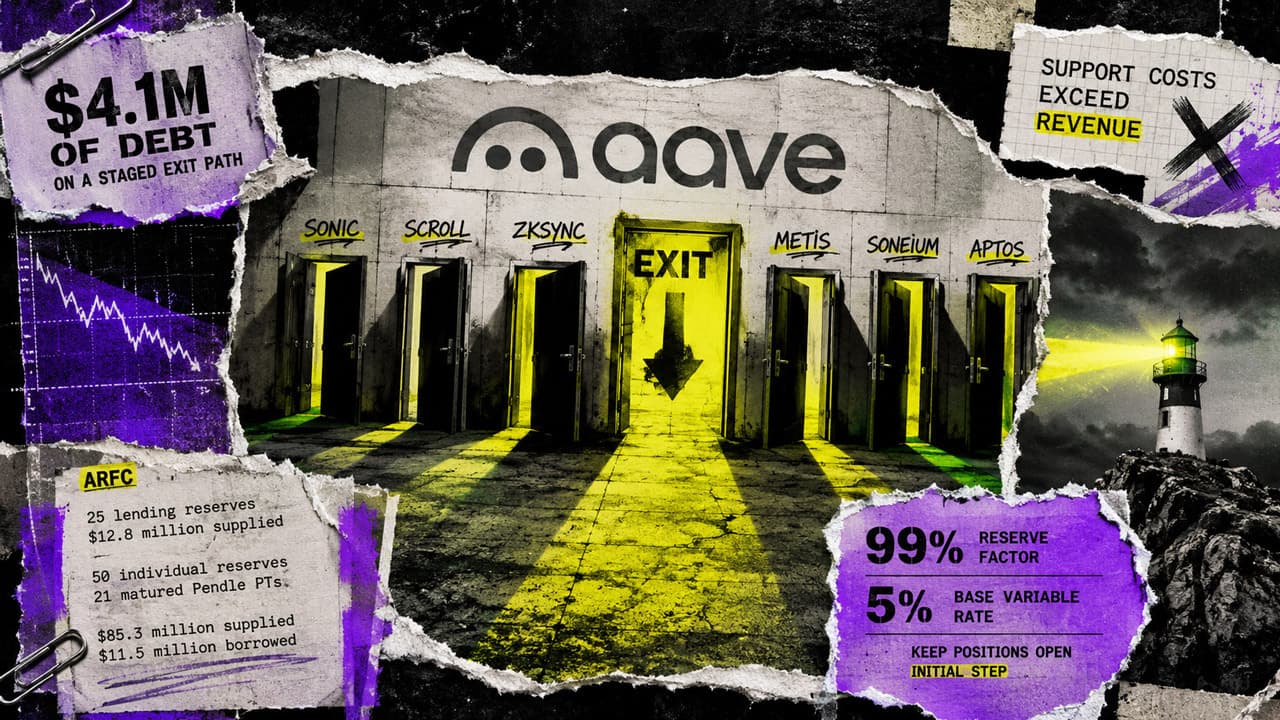
A new proposal from Aave's risk service provider, LlamaRisk, recommends the decentralized lender cease its V3 operations on six blockchains: Sonic, Scroll, zkSync, Metis, Soneium, and Aptos. The plan, introduced in a forum post on July 29, would set a staged exit path for $4.1 million of debt, allowing existing positions to remain open during the initial phase.
The proposal includes freezing new activity, redirecting almost all interest revenue to the Aave treasury, and keeping more forceful unwinding measures in reserve for potential later use.
Proposal Details and Governance Path
This Aave Request for Final Comments (ARFC) covers 25 lending reserves that hold $12.8 million in supplied assets, according to data from LlamaRisk dated July 28. As of July 31, the request was still under discussion in the forum. In Aave's governance lifecycle, an ARFC precedes a community Snapshot vote and any subsequent on-chain Aave Improvement Proposal that would execute the changes.
In addition to the six full-market exits, the same ARFC targets another 50 individual reserves and 21 matured Pendle principal tokens spread across 11 different deployments. These separate assets account for $85.3 million in supplied funds and $11.5 million in borrowed funds.
The Economic Rationale for Closure
LlamaRisk's recommendation is based on a simple economic calculation: the costs to support these deployments are greater than the revenue they generate. The provider stated that the deployments on Sonic, Scroll, and zkSync each produce less than $5,000 in quarterly protocol revenue based on current balances. Meanwhile, the deployments on Metis, Soneium, and Aptos each bring in less than $1,000 per quarter.
While the proposal references expenses related to oracles, monitoring, and operational support, it does not provide a specific figure for the financial shortfall.
A Phased Wind-Down Strategy
The proposed exit for the six full markets would begin with several key actions. Every reserve on these chains would be frozen, and their supply and borrow caps would be reduced to 1. For reserves that currently carry debt, two additional changes would be implemented: a 99% reserve factor and a 5% base variable rate for the interest rate model. Reserves without any borrowed assets would not be subject to these latter two adjustments.
These two settings are designed to influence different market participants. The 5% base rate directly applies to the cost of borrowing. The 99% reserve factor, which dictates how interest income is allocated, would channel nearly all interest payments from borrowers directly to the Aave treasury, leaving very little to be earned by suppliers. LlamaRisk anticipates that this reduction in yield will incentivize suppliers to withdraw their assets, which in turn increases utilization and creates a stronger motive for borrowers to repay their loans.
Impact on Users and Future Steps
A "freeze" on these reserves means that no new funds can be supplied, no new loans can be taken out, and assets cannot be used as new collateral. However, all positions that are already open would not be immediately affected. The starting conditions for this process vary; according to the July 28 data, all listed reserves on Sonic and Aptos were active, whereas all listed reserves on Scroll, zkSync, Metis, and Soneium had already been frozen.
This staged approach aims to minimize the risk of immediate liquidations while retaining more significant measures if asset balances do not decrease. LlamaRisk noted that future actions could involve raising interest rate curves or incrementally lowering the liquidation thresholds for specific collateral. Any additional unwinding activities would be evaluated on a case-by-case basis.
As the wind-down progresses, users who choose to keep their positions open could face subsequent changes to interest rates, collateral requirements, and oracles. Once positions have been further unwound, the oracles for these deployments might be substituted with fixed-price adapters, following a method outlined in a companion oracle proposal.
Discussion about this post
No comment yet
Be the first to share your opinion!