
News
Platform news and market context
News
Platform news and market context
Solana Group's $18B Crypto Crash Claim Contradicted by Public Data, Revealing Major Reporting Gaps
A research group aligned with Solana claimed $18 billion in liquidations occurred during a 2025 crypto crash, but public data from other sources shows a much lower figure of $9.89 billion, highlighting a significant data discrepancy and the difficulty in comparing market stress events across different platforms.
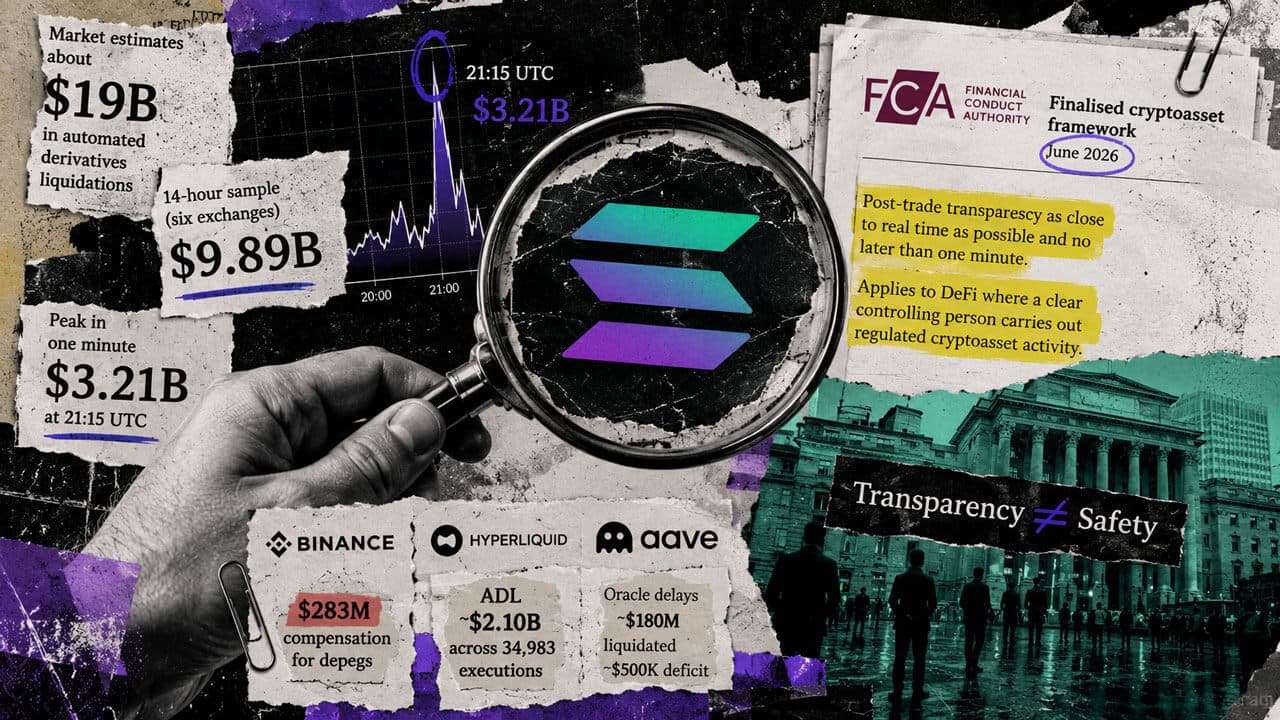
A recent analysis by the Solana Research Institute (SRI), a research entity with ties to Solana, has brought renewed attention to a July open letter from Angus Scott directed at the UK Financial Conduct Authority and other regulators. In an Aug. 14 post, SRI asserted that during the crypto crash on October 10, 2025, approximately $18 billion in liquidations took place over a 14-hour period, with a staggering $3.21 billion occurring in a single minute. The group's argument posited that opaque centralized finance platforms failed under pressure, while transparent on-chain systems continued to operate effectively.
However, a closer look at the public records from the crash suggests a more nuanced reality. The available data enabled the reconstruction of a significant auto-deleveraging event on the platform Hyperliquid, and also revealed deficits and oracle delays at Aave. Furthermore, a later review by ESMA concluded that Binance’s use of internal collateral pricing actually amplified forced selling. This transparency exposed the specific mechanics of stress across varied market structures, challenging the idea that one type of venue could be considered a simple proxy for safety.
The Problem of Mismatched Data
A significant discrepancy exists between the figures reported by different sources. While the Solana Research Institute's post mentioned the $18 billion total and a one-minute peak of $3.21 billion, a separate six-exchange analysis by Amberdata also identified the $3.21 billion peak at 21:15 UTC, noting that forced selling accounted for 93.5% of liquidations in that minute. For the entire 14-hour window, however, Amberdata's total was only $9.89 billion, with $6.93 billion of that concentrated in the 40-minute span from 20:50 to 21:30 UTC.
The July 23 letter from the Solana Research Institute, which announced the $18 billion figure, fails to provide a common set of venues or an aggregation methodology that would reconcile its total with Amberdata’s $9.89 billion. This suggests the issue is a measurement gap, not a simple calculation error. Separately, an ESMA review referenced market estimates of around $19 billion in automated derivatives liquidations for the entire day.
These varying numbers describe different scopes and answer different questions, including a day-long market estimate, a 14-hour sample from six exchanges, a one-minute peak, and losses from a venue-specific mechanism. Combining them into a single, overarching total obscures the critical details of market infrastructure that the policy debate aims to illuminate.
A Closer Look at Venue Failures
The concept of auto-deleveraging, or ADL, is central to understanding these events. ADL is a last-resort mechanism in derivatives trading that forcefully reduces the positions of profitable traders to keep a venue solvent when liquidations and risk buffers are insufficient. This process is distinct from an ordinary liquidation, where a losing position is closed because its collateral has dropped below a required level. For regulators, having comparable records is essential to distinguish these mechanisms from other issues like a system outage, an oracle delay, or a pricing failure specific to one venue.
Binance’s postmortem on the event illustrates the complexity. The exchange reported that its spot and futures matching engines, along with API trading, stayed operational. However, some modules experienced glitches after 21:18 UTC, and both internal transfers and Earn redemptions saw delays. Crucially, local prices for collateral assets like USDe, BNSOL, and WBETH became dislocated after 21:36 UTC. Binance stated it issued about $283 million in two compensation batches to users who were liquidated due to these depegs.
ESMA’s analysis added that Binance's practice of using internal prices for collateral allowed these local depegs to quickly diminish collateral value, which in turn triggered forced liquidations and a cascade of selling. While the regulator noted no observable spillover into traditional financial markets, its report highlights how a specific venue's design can act as an amplifier, a factor that a single market-wide liquidation figure cannot isolate. The available evidence does not permit ranking centralized-exchange ADL as the crash's primary systemic failure, as the Binance report gives no event-specific ADL total. Instead, the record separates the event into distinct issues: module delays, transfer problems, collateral-pricing dislocations, and standard forced liquidations.
Transparency Reveals On-Chain Risks
Transparent platforms like Hyperliquid and Aave, which disclose different risk engines and loss outcomes, offer records that make comparisons possible, but only if their unique characteristics are kept visible.
Data on Hyperliquid, sourced from a non-peer-reviewed study using public venue data, confirms that large-scale ADL also happened on an on-chain derivatives platform. This finding establishes that the mechanism was not exclusive to centralized exchanges, while also showing its design and outcomes were distinct from those at Binance.
Similarly, a Chaos Labs report on Aave detailed five-block price-update delays in some markets. Chaos Labs calculated that after accounting for reported deficits, the protocol remained net positive by approximately $1.5 million thanks to liquidation fees and SVR revenue.
In these cases, public records made it possible to measure aspects of Hyperliquid’s loss allocation and Aave's lending stress. Yet, these same records also documented ADL, oracle latency, and bad debt. The observability provided outsiders with a superior audit trail, but the underlying mechanisms themselves still resulted in losses and operational risks for users.
The Path Forward: Regulation and Observability
Even with faster trade data, the chain of losses remains fragmented. The Solana Research Institute notes that its 33-page letter, which addresses seven domains including identity, resilience, and systemic risk, was the result of discussions between the FCA and the Solana Foundation. The October 10 crash serves as just one case study within this broader argument.
The FCA has already begun to address the transparency issue. Its June 2026 final cryptoasset framework will mandate that UK-qualifying cryptoasset trading platforms and principal dealers must publish post-trade information as close to real time as possible, with a maximum delay of one minute. Larger UK platform operators will also be subject to pre-trade transparency rules. This framework extends to DeFi when a distinct controlling entity is conducting regulated cryptoasset activities. However, activities deemed genuinely decentralized may fall outside this regulation, and a separate consultation on DeFi guidance is still anticipated.
Notably, the final framework does not explicitly mandate standardized, cross-venue reporting for liquidation volumes, the use of ADL, or backstop losses. As the records from October 10 demonstrate, even with faster trade data, it remains difficult to compare operational delays, pricing failures, and loss-allocation mechanisms after a common market shock.
The strongest part of Solana Research Institute’s policy case emerges when it centers on this observability gap. The crash demonstrated that public records can make venue failures measurable, even on transparent platforms. The implementation of comparable event disclosures could empower regulators to differentiate between routine solvency controls and venue-specific operational or pricing failures, without misconstruing transparency itself as an automatic guarantee of safety.
Discussion about this post
No comment yet
Be the first to share your opinion!