
News
Platform news and market context
News
Platform news and market context
Trump and Top Regulators to Host Crypto Leaders from Coinbase and Ripple as Key Legislation's Prospects Fade
President Donald Trump, alongside the heads of the SEC and CFTC, is set to meet with executives from major crypto firms like Coinbase and Ripple next week. This high-stakes gathering comes as the CLARITY Act, a landmark piece of crypto legislation, faces collapsing odds of passing this year, now estimated as low as 10%.
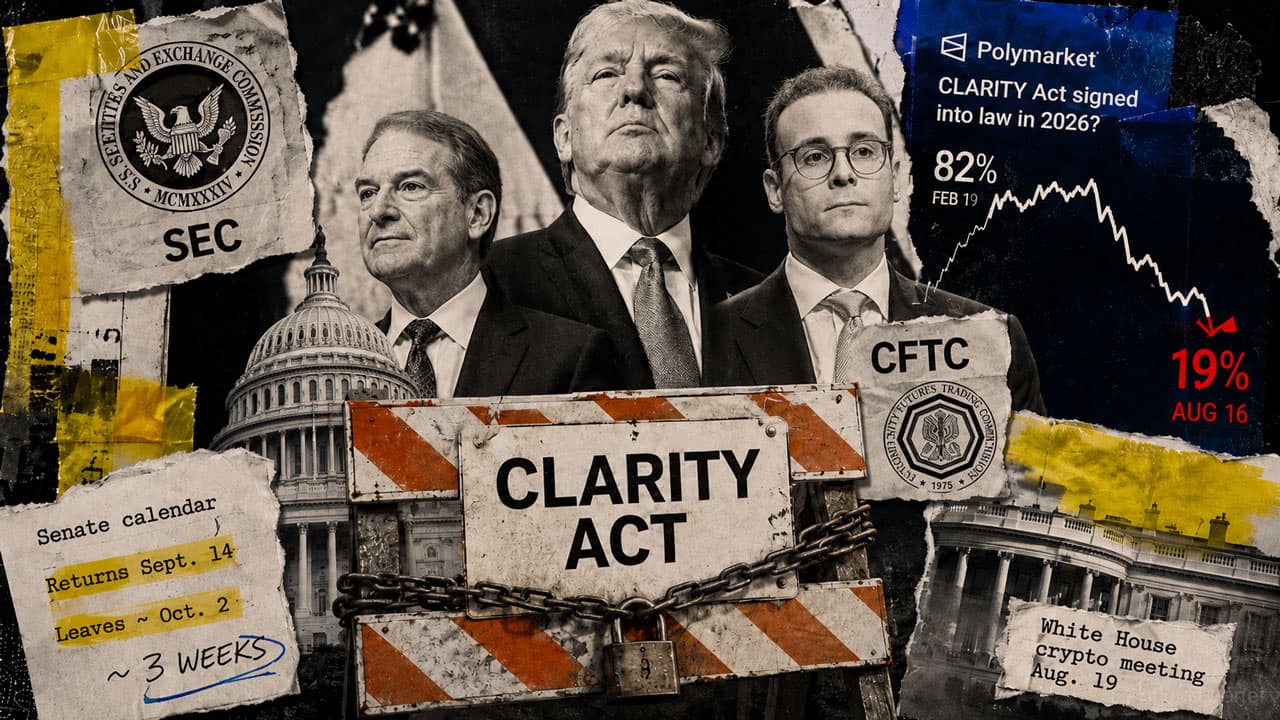
A high-profile White House meeting is scheduled for next week, bringing together President Donald Trump, top financial regulators, and leaders from the cryptocurrency and prediction-market industries. The gathering on August 19 occurs as the sector's most significant legislative effort, the Digital Asset Market Clarity Act, sees its chances of becoming law this year plummet.
The expected guest list features executives from prominent firms including Coinbase, Andreessen Horowitz, Ripple, Chainlink, Kalshi, and Paradigm, along with representatives from the Digital Chamber. Invitations were also extended to Kraken, Gemini, the New York Stock Exchange, and Nasdaq. On the government side, President Trump is expected to participate, along with Commodity Futures Trading Commission (CFTC) Chair Michael Selig and Securities and Exchange Commission (SEC) Chair Paul Atkins. The final attendance list remains subject to change.
Legislative Hopes Dwindle
The timing of this summit is critical, as it comes less than a month before the Senate is scheduled to take its next procedural step on the Digital Asset Market Clarity Act. This legislation is intended to establish a federal regulatory structure for crypto markets and divide oversight between the SEC and CFTC.
However, its prospects have dimmed considerably. On Saturday, Polymarket traders assigned the CLARITY Act a mere 19% probability of being signed into law by 2026, a sharp decline from a peak of 82% on February 19. Even that reduced market-implied probability is nearly double the 10% estimate for passage this year from Galaxy Digital.
CLARITY began the summer with something few major crypto bills achieve: substantial bipartisan support in both chambers of Congress. That coalition has since fallen apart due to disputes that are more about the politics surrounding crypto regulation than its actual architecture.
The Senate Banking Committee advanced the legislation with a 15-9 vote on May 14, where Democratic Senators Ruben Gallego and Angela Alsobrooks joined all 13 Republicans in support. The House had previously approved its version, H.R. 3633, by a 294-134 margin in July 2025, with 78 Democrats backing the measure.
Political Roadblocks Emerge
Negotiations deteriorated over several key sticking points, including restrictions on crypto activities by senior government officials, limits on stablecoin rewards, and protections against illicit finance. Banks have also been lobbying lawmakers to restrict the rewards offered by stablecoin platforms, expressing concerns that such yield-bearing products could draw deposits away from the traditional banking system.
The primary obstacle now is an ethics dispute concerning Trump's own crypto ventures. Galaxy Digital has noted that the legislation has effectively transitioned from a policy negotiation into a political one. Although a bipartisan group of senators sent a proposed ethics framework to the White House on July 30, the administration has not publicly agreed to it. Without a compromise, Galaxy said supporters might lack a viable path to the 60 Senate votes required to advance the bill.
This stalemate pushed CLARITY past the Senate's August recess without a floor vote. Nevertheless, Senate Majority Leader John Thune filed cloture on the motion to proceed before lawmakers left Washington, setting up an early test when the Senate returns on September 14.
The calendar leaves little margin for another breakdown. The Senate is expected to be in session for only about three weeks before lawmakers depart around October 2 for midterm election campaigning. Galaxy estimates that CLARITY would need to begin moving almost immediately and consume a significant portion of that limited time to have a realistic chance of clearing the chamber this year. This elevates the significance of Wednesday's White House gathering, where executives will meet officials just weeks before the Senate decides if CLARITY has enough political will to survive.
Regulators Move Forward Independently
As the CLARITY Act encounters political and scheduling hurdles in the Senate, the SEC and CFTC are already testing how much of Washington’s crypto agenda can be advanced under existing law.
Under Chair Atkins, the SEC has been developing two major initiatives: Reg Crypto, a tailored framework for certain crypto offerings, and an Innovation Exemption that would permit limited experimentation with tokenized securities and onchain trading. However, progress has been uneven. The commission had scheduled an August 14 vote on the crypto-offering proposal before canceling the meeting a day earlier without setting a new date. The separate Innovation Exemption has also faced delays amid resistance from parts of the traditional securities industry. Both initiatives address questions that CLARITY aims to settle more permanently, including how digital assets can be issued and traded and which federal rules should apply.
Meanwhile, the CFTC is moving more aggressively. Chair Selig said the agency needs to hear directly from the companies building new financial products if regulators are to keep pace with innovation. The CFTC will convene its inaugural Innovation Advisory Committee meeting on August 20, bringing together executives, entrepreneurs, and market participants to discuss the future of financial regulation.
The agency's increasingly assertive approach to prediction markets was on display on August 11, when the CFTC invoked emergency authority after Kalshi warned that a lawsuit from New York could disrupt its federally regulated event-contract market nationwide. Selig ordered the exchange to continue operating under federal derivatives rules and has argued that states cannot override the national framework governing CFTC-regulated markets. That dispute is part of a broader fight between the commission and several states over whether prediction contracts should be governed primarily by federal derivatives law or state gambling rules.
While the SEC and CFTC cannot replicate the full scope or permanence of CLARITY through exemptions, rulemaking, and interpretations, both agencies are already attempting to establish parts of the regulatory framework Congress has yet to enact. That tension will carry into the White House gathering, where Atkins and Selig are expected to meet executives whose businesses sit directly at the center of both the stalled legislation and the regulators' efforts to move without it.
Discussion about this post
No comment yet
Be the first to share your opinion!