
News
Platform news and market context
News
Platform news and market context
ZisK Claims Four-GPU Solution for Ethereum Proving, Halving Previous Hardware Estimates Amid Scrutiny
A new benchmark claim from ZisK suggests a four-GPU setup can meet Ethereum's real-time proving latency targets, a significant reduction from a prior 12-GPU estimate. However, the project has yet to disclose crucial workload and power details required for independent verification against Ethereum's decentralization goals.
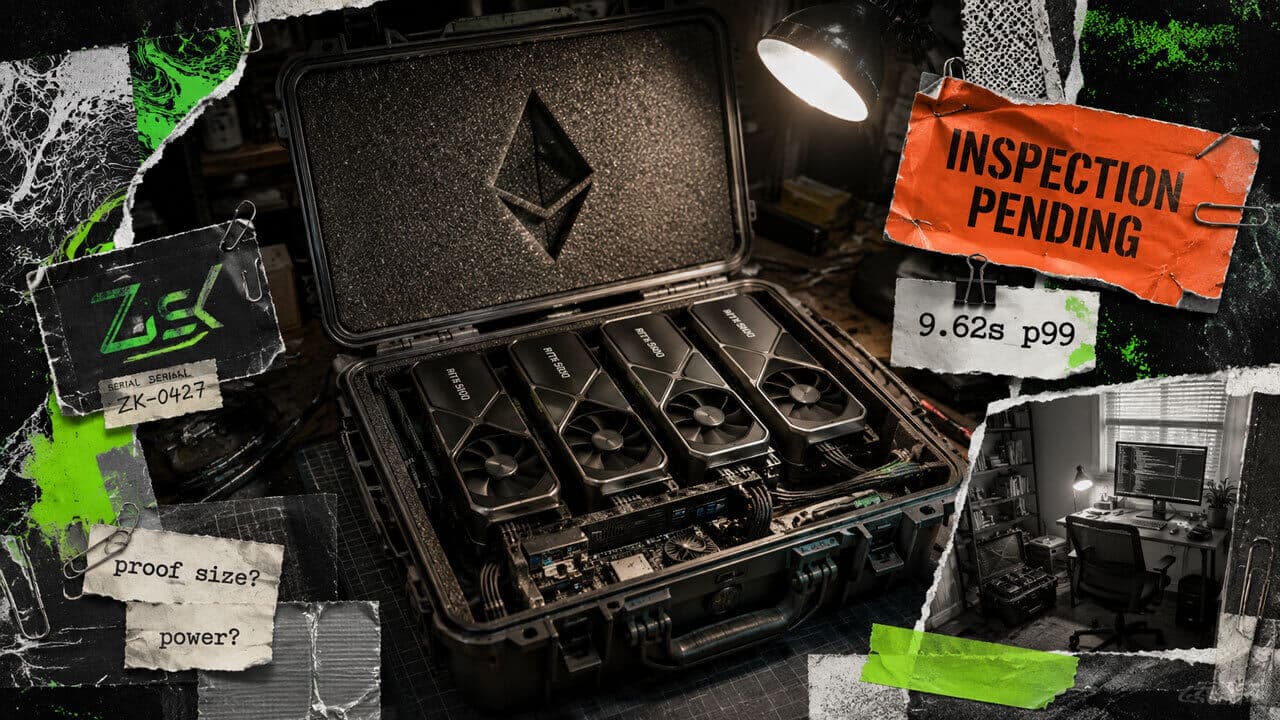
A new benchmark from ZisK, an open-source zero-knowledge virtual machine project, has reduced the headline hardware count in the race for real-time Ethereum proving. The claim of a four-GPU solution could bring proof generation closer to the reach of independent operators, assuming the workload and operating conditions are comparable to established standards. This development follows a February analysis by CryptoSlate that identified a setup of roughly 12 GPUs as a potential centralization risk.
The Four-GPU Benchmark
On August 18, ZisK said its v1.1.0-alpha prover achieved a 9.62-second p99 latency using four RTX 5090 GPUs. A subsequent post stated that 99.7% of the Ethereum blocks it tested were processed in under 10 seconds.
The announcement was amplified by Jordi Baylina, who hailed the result as a milestone for combining four-GPU proving with what is claimed to be 128-bit security and post-quantum resistance.
Ethereum’s working standard for this technology mandates that at least 99% of mainnet blocks must be provable within a 10-second window. If ZisK calculated its p99 metric over an equivalent mainnet-block workload and timing boundary, its 9.62-second figure would position it 0.38 seconds inside that critical threshold.
Missing Details and Outstanding Questions
Despite the promising headline number, ZisK has yet to publish several key pieces of information regarding the four-GPU run. The announcement is currently considered a benchmark claim because details such as the specific block range, sample size, p99 calculation method, timing boundary, final proof size, and measured whole-system power consumption remain undisclosed.
To preserve decentralization, the Ethereum Foundation has paired its latency target with five other conditions:
- On-premises equipment costing no more than $100,000
- Power consumption no higher than 10 kilowatts
- Fully open-source code
- A security level of at least 128-bit
- Proofs no larger than 300 KiB without trusted setups
CryptoSlate has previously tracked the Foundation's emphasis on meeting the 128-bit security threshold. ZisK’s repository is licensed under MIT or Apache 2.0, and the project asserts 128-bit security for its new result. However, the latency condition remains provisional until the workload and measurement specifics needed for an equivalent test are made available.
Hardware Feasibility and Practical Hurdles
The hardware arithmetic appears promising but does not entirely resolve questions of household practicality. Nvidia specifies a total graphics power of 575 watts for a reference RTX 5090. Consequently, four of these cards would have a combined GPU-only rating of 2.3 kW. This figure sits comfortably below the 10 kW ceiling, even before factoring in CPUs, memory, storage, power conversion losses, and cooling systems.
In terms of cost, Nvidia launched the RTX 5090 with a starting price of $1,999. Four cards at launch MSRP would total $7,996, leaving substantial financial room below the $100,000 equipment cap for the other components of a multi-GPU machine.
Nevertheless, a rig that fits within a nominal budget can still impose significant strain on a smaller operator's power delivery, cooling infrastructure, or host-hardware capacity. Furthermore, the rapid generation of proofs must also comply with Ethereum’s rules regarding proof size and setup procedures.
Comparing Results and Verifying Claims
For context, OpenVM’s July production release reported a 9.8-second p99 on eight 5090 GPUs. That run was conducted across 7,200 Ethereum mainnet blocks, beginning at block 24,000,000, and used 100-bit provable security to produce proofs under 300 kB.
While ZisK’s four-GPU figure may signal a genuine gain in efficiency, the absence of equivalent inputs prevents a reliable ranking against competitors. The security levels differ, ZisK has not yet tied a proof size to its result, and its tested block population and timing boundary remain unpublished.
The Ethproofs API defines proving time as a metric that includes witness generation but excludes data fetching and proof-submission latency. A p99 value calculated using a different interval could appear similar while measuring a different operational burden.
Currently, the Ethproofs API lists ZisK versions only up to v0.18.0 and exposes a 16-GPU RTX 5090 ZisK configuration. An independent result for a four-GPU v1.1.0-alpha has not yet appeared, leaving the announcement without a public baseline for reproducibility.
ZisK’s own release history identifies v1.1.0-alpha, and its repository describes the current line as a foundation for a future production release that is undergoing security and correctness audits. An OpenZeppelin review published in November 2025 examined a limited set of ZisK binary and main constraints from a historical commit. The review reported 13 findings, one of which was critical and two were high-severity, with none marked as resolved within that report.
Path to Validation
The claim from ZisK has weakened the simple objection that proving requires data-center scale, but the operational case remains open. For this result to be considered evidence of a home-proving breakthrough, the project would need to provide a disclosed mainnet block set, a complete timing definition, sub-300-KiB proofs generated without a trusted setup, measured wall power data, and an independently runnable release.
Discussion about this post
No comment yet
Be the first to share your opinion!