
News
Platform news and market context
News
Platform news and market context
Strategy Spends Over $100M to Defend STRC Stock as DeFi Firm Slices Risk for a 'Safer' 7% Yield
DeFi platform Solstice has introduced a new product that separates the risk of Strategy's STRC preferred stock into tranches, offering a senior portion with a 7% APY that is protected from losses unless the stock price halves. This development occurs as Strategy actively defends its stock, having recently spent over $100 million on repurchases to maintain a price near $100.
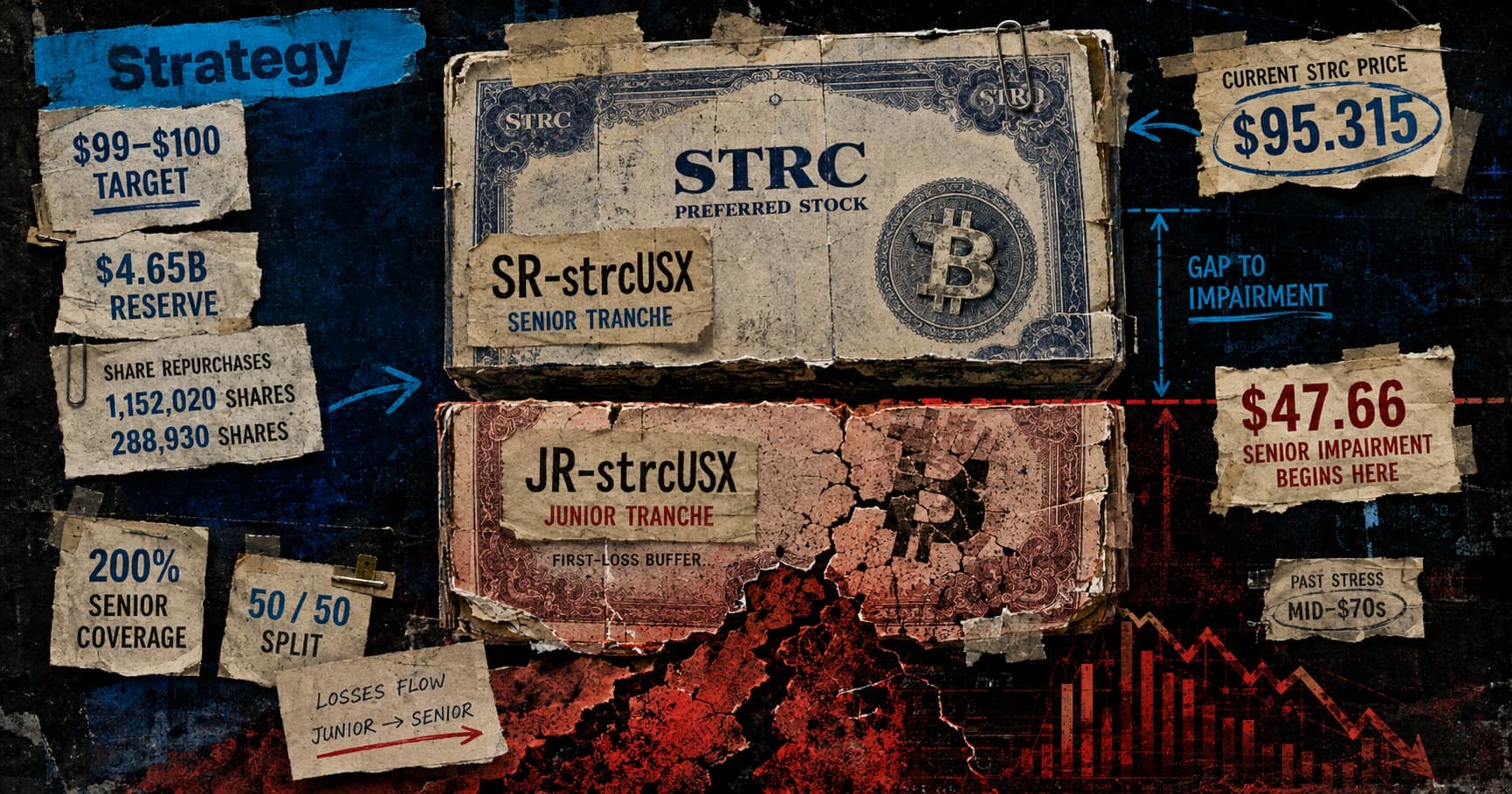
A new tranched product from Solstice, built upon Strategy's Bitcoin-related STRC preferred stock, has been announced, with the firm stating that its senior tranche would only begin to absorb losses if STRC's price were to drop below $47.66. Currently, STRC is trading near $95.315, placing that critical threshold at roughly half of its present market value and approximately 52% below the security's $100 par value.
Solstice Chief Operating Officer David Plisek clarified that the $47.66 figure represents a modeled senior-impairment threshold based on the protocol's existing coverage structure and assumptions, both of which the team has the ability to revise.
Strategy's Active Price Defense
Strategy has been vigorously managing the price of STRC over the past six weeks. On June 29, the company unveiled a Digital Credit Capital Framework, which integrates a dollar reserve policy, an adjusted dividend structure, and authorizations for repurchases. The explicit objective of this framework is to maintain STRC's trading price within the $99 to $100 range.
To that end, Strategy repurchased 288,930 shares of STRC for roughly $25 million between July 20 and July 26, achieving an average price of about $86.52 per share. Following this, in early August, the company liquidated $108.6 million of its Bitcoin holdings and used the funds to buy back an additional 1,152,020 STRC shares. These actions were supported by a reported $4.65 billion dollar-denominated reserve as of August 9.
Solstice has constructed its risk model with this policy as a foundation, and its official documentation explicitly identifies any deviation from this strategy as a named risk.
How Solstice Structures the Risk
According to Plisek, the exposure is divided into two distinct tokens: SR-strcUSX for the senior tranche and JR-strcUSX for the junior one. For every $100 of combined exposure, $50 is allocated to each token. This 50/50 distribution results in a 200% senior coverage ratio.
In this structure, the junior tranche is the first to absorb any realized losses. In return for taking on this initial risk, it targets a yield significantly higher than the senior side's approximate 7% APY. For context, STRC's stated 12% annual dividend translates to a Bitcoin-fueled yield of nearly 12.59% at its current price, a spread that Solstice's tranching and fees then distribute between the two new tokens.
Plisek characterized the tranching mechanism as a method for providing investors with a NAV-based return on STRC, distinct from exposure to the security's price fluctuations. The product offers structured exposure to the economics of STRC—a claim on the security's performance without conferring actual share ownership.
Safeguards and Stress Scenarios
Solstice conducted a retrospective analysis to model how its structure would have performed during STRC's previous decline into the mid-$70s, before this product was available. During that period, STRC hit a low near $73.62, which is still about 35% above the current impairment threshold of $47.66.
In that modeled scenario, the senior tranche remained unimpaired, regardless of the actions taken by junior holders. The outcome for the junior tranche, however, was entirely dependent on the behavior of senior investors. Plisek noted that the junior tranche would have also avoided impairment if senior holders had remained invested throughout the drawdown. Conversely, had every senior holder redeemed their position during that window, the junior tranche would have experienced a drawdown of approximately 50%.
A price drop only converts into a realized loss when redemptions compel the structure to sell its underlying asset. Consequently, junior tranche losses are triggered when senior holders rush to exit simultaneously during a price decline.
To mitigate this, Solstice has implemented built-in protective stages. If STRC's price falls below a certain threshold, the protocol activates a restricted mode, which simultaneously freezes both junior redemptions and the creation of new senior tokens. This is designed to prevent further deterioration of the coverage ratio while the restrictions are active. Should the price fall even further, a liquidation phase is initiated, during which Solstice endeavors to sell the STRC collateral before the senior tranche incurs any loss.
Plisek added that market makers have committed to purchasing STRC outside of standard Nasdaq trading hours. This arrangement helps bridge the gap between a continuously traded DeFi product and an underlying security with limited trading hours. He also affirmed that the protocol's products function independently; a liquidation event in the STRC product would not impact Solstice's other offerings, such as USX or eUSX, as each has its own distinct risk controls.
The Bull and Bear Outlook
Ultimately, the tranche structure reorganizes who bears STRC's risk, but the underlying risk itself remains unchanged. Strategy has clarified that STRC dividends are subject to board approval each period and that the preferred securities do not have a collateral claim on the company's Bitcoin holdings, only a preferred claim on any remaining assets.
The bull case for this arrangement posits that Strategy's repurchases and reserve policy will succeed, causing STRC's price to close the gap and return to its $99 to $100 target. As this discount narrows, the mark-to-market risk for the junior tranche diminishes, and the senior tranche begins to resemble a bond more than a leveraged bet. In this scenario, Solstice's structure successfully provides what Plisek described: a NAV-based return that exchanges STRC's volatility for a more stable investment.
The bear case, however, envisions STRC sliding back toward the mid-$70s as the market becomes increasingly skeptical of a Bitcoin treasury company's ability to fund its preferred-stock defense indefinitely. While the senior tranche is modeled to remain unimpaired either way under Solstice's framework, the fate of the junior tranche hinges on whether its holders stay invested or rush for the exits in unison—the very redemption pattern Solstice's retrospective model identified as the decisive factor.
Solstice has engineered a system that predetermines the order of losses should STRC fall. The integrity of the $47.66 line of defense depends entirely on whether the mechanics between the current price and that threshold—including the tranching, restrictions, and liquidation process—all function as designed under the pressure of real market stress.
Discussion about this post
No comment yet
Be the first to share your opinion!