
News
Platform news and market context
News
Platform news and market context
As Treasury Yields Approach 5.2%, a $125 Billion Auction Series Poses a Key Test for Bitcoin's Market Resilience
The U.S. Treasury is set to auction $125 billion in debt from August 11-13, coinciding with key inflation data releases that will test Bitcoin's sensitivity to rising bond yields. However, historical research from the New York Fed suggests the cryptocurrency has often remained disconnected from such major macroeconomic events.
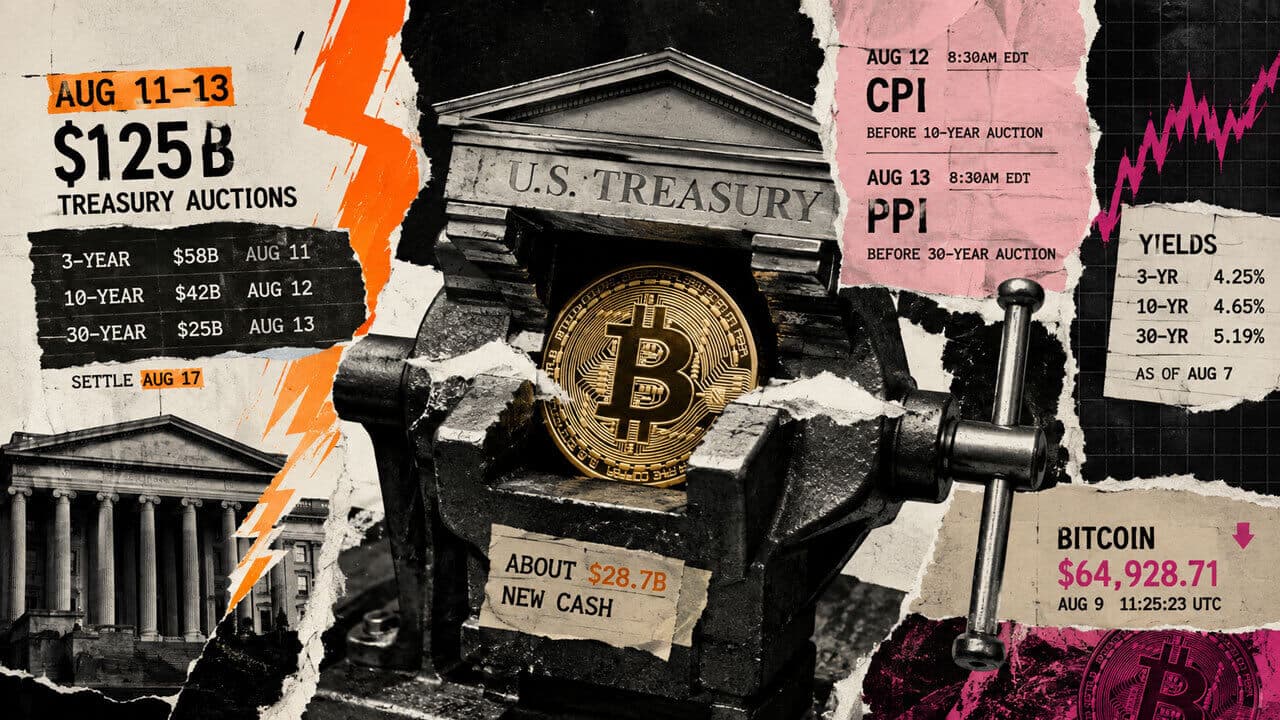
A significant test of Bitcoin's reaction to market pressure is approaching as the U.S. Treasury prepares for a series of auctions totaling $125 billion, scheduled from August 11 through August 13. The situation is intensified by the release of two inflation reports, which are due just hours before the corresponding 10-year and 30-year bond sales. This sequence of events will provide a clear look at whether softening demand for bonds, and any subsequent increase in yields, exerts downward pressure on Bitcoin.
A Packed Schedule of Auctions and Data
The Treasury's refunding plan kicks off on August 11 at 1 p.m. EDT with the sale of $58 billion in 3-year notes. This is followed by a $42 billion auction of 10-year notes at the same time on August 12, and concludes with $25 billion in 30-year bonds on August 13. All three of these debt issuances are scheduled to settle on August 17.
It is important to note that the gross total of $125 billion does not represent a direct liquidity withdrawal from the market. A substantial portion, approximately $96.3 billion, is designated to refinance privately held debt that matures on August 15. This leaves a remainder of about $28.7 billion in new cash that will need to be raised from investors.
Adding to the market's focus, the Bureau of Labor Statistics calendar has scheduled the release of the July Consumer Price Index (CPI) for 8:30 a.m. EDT on August 12. This is precisely four and a half hours before the 10-year auction begins. The following day, the July Producer Price Index (PPI) will be released at 8:30 a.m., maintaining the same time interval before the 30-year bond sale. The tight timing of these data releases and Treasury auctions creates a concentrated test of bond demand and Bitcoin’s corresponding behavior.
Setting the Baseline
As of the last official business-day cutoff on August 7, the Treasury's par-yield curve indicated yields of 4.25% for 3-year notes, 4.65% for 10-year notes, and 5.19% for 30-year bonds. For comparison, a CryptoSlate snapshot taken on August 9 at 11:25:23 UTC recorded Bitcoin's price at $64,928.71, though this live price is sensitive to its specific timestamp. These two data points, the Sunday Bitcoin quote and the Friday Treasury fixing, do not offer simultaneous market evidence. Consequently, any potential correlation between yields and Bitcoin must be evaluated in the context of the forthcoming inflation reports and auction outcomes.
The results from the July Treasury auctions provide a baseline for the upcoming August sales. FinancialJuice reported that the 3-year and 10-year sales in July both "stopped through" their when-issued yields by 0.6 basis points, while the 30-year sale stopped through by 0.3 basis points. Because the Treasury does not publish when-issued levels, this tail comparison serves as a secondary benchmark rather than an official statistic.
Potential Scenarios for Bitcoin
A comparatively weak performance in the August auctions would be characterized by a combination of factors: a positive tail, a bid-to-cover ratio that is lower than the July sale, and a smaller share of indirect bidders. It is crucial to remember that a single metric is not definitive, and the comparison is also influenced by the auction's size and the reopening status of the longer-term securities.
The more acute risk scenario for Bitcoin is conditional. It would unfold if higher-than-expected inflation pushes yields up, multiple auction metrics signal weaker demand, yields consequently stay elevated, and Bitcoin's price falls within the same event window. Conversely, this case would be weakened by firm auction results or if Bitcoin's price remains stable through the period.
Highlighting the uncertainty, historical analysis from New York Fed research found that Bitcoin has been broadly disconnected from monetary and macroeconomic news within its sample. This precedent underscores why the upcoming Treasury auctions should be viewed as a test of current conditions, not as an automatic sell signal for the cryptocurrency.
Discussion about this post
No comment yet
Be the first to share your opinion!